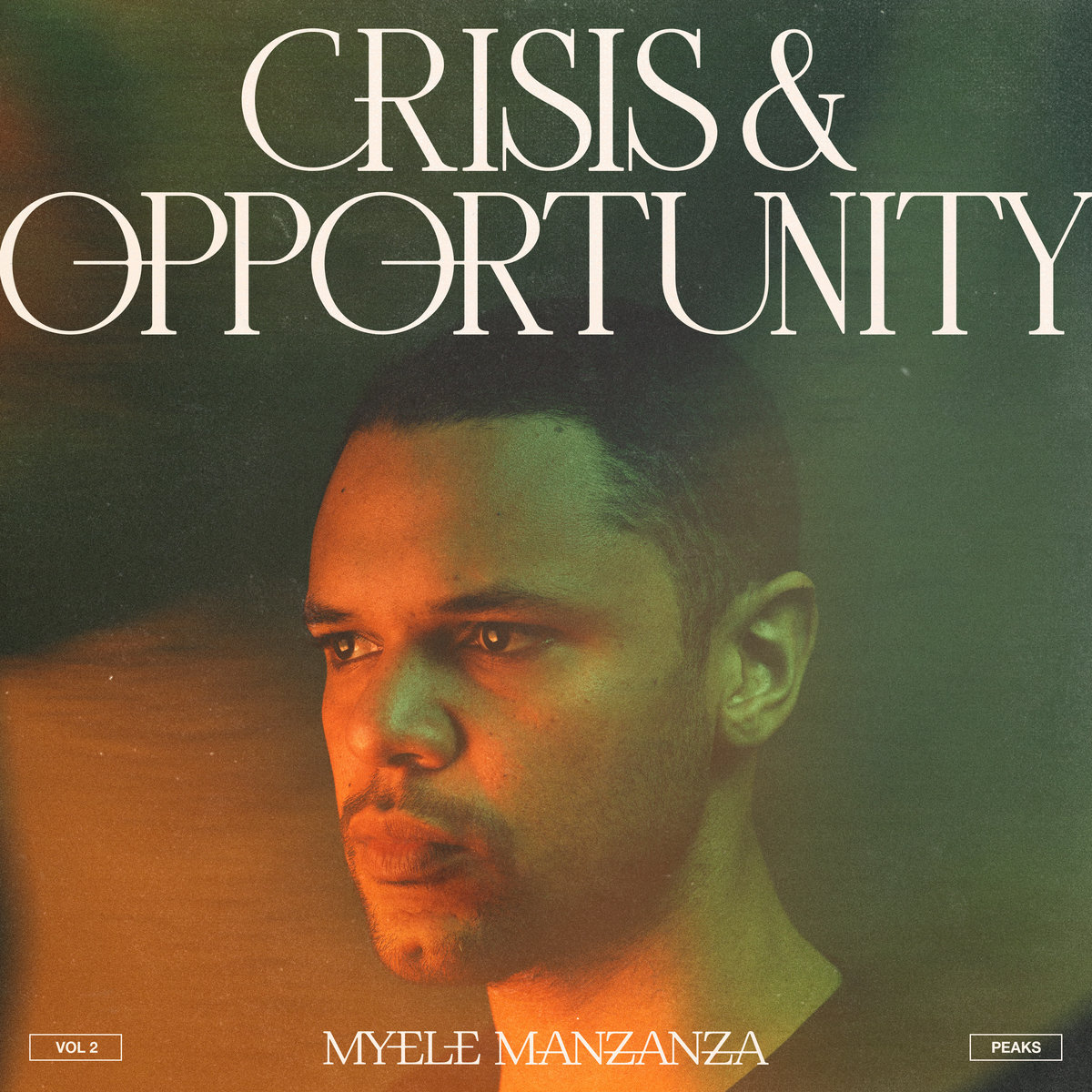
Myele Manzanza Crisis & Opportunity Volume 2 – A Uniquely Rhythmical and Genre-Defying Experience
Soul Brother Records’ Will Fox surveys the latest Myele Manzanza Album on Deepmatter Records
Myele Manzanza, New Zealand born drummer and son of Congolese percussion master Sam Manzanza, returns with another thrilling edition of the Crisis and Opportunity series on Deepmatter Records, volume two out of five. Featuring a predominantly New-Zealand / Antipodean cast of players—Manzanza on drums and percussion, Ashton Sellers on guitar, Aron Ottignon on piano, synths and vocoder, Matt Dal Din on bass and Lewis Moody on synthesisers—the album was predominantly written and recorded in Berlin, a city that Myele previously inhabited, certainly a wellspring of influence for him as far as his self-penned liner notes detail.
The spirit of the album and its musicianship, while retaining relatively close ties to Crisis and Opportunity Volume 1, has evolved past the quintet style in which the former was recorded, approaching more broken, truncated musical territories and embracing a more experimental register, punctuated by pulsating, pneumatic electronic instrumentation and lower frequencies, head-boppy and unquantized rhythmical arrangements and plenty of avant-garde musical movements and genre-defying narratives.
Long solo sections have been eschewed with Manzanza opting to build the tracks with a more united and cooperative approach while—naturally—retaining strong stylistic and performative attachments to Jazz, particularly the newer breed of London Jazz that has been seeping out of South-East London over the past decade. Perhaps Manzanza’s residence in Greenwich is emblematic of the wider reach of that movement, and the rhythmical capital it carries with it… The presence of Mark de Clive Lowe in the first album did underscore the sound with a pronounced connection to electronic music—which clearly bears a large influence on Manzanza, having previously been deployed as Theo Parrish’s live drummer while also having cut his teeth as the principal drummer for Electric Wire Hustle— and it seems as though Volume 2 has picked up the electronic mantle where de Clive Lowe left off: with renewed rigour and beatmakerish flare.
Having seen Manzanza perform live at Ronnie Scotts and at Woolwich Works, I would be hard pressed to describe his style of playing relative to any particular drummer or genre. He comes across in his playing like a mixture of Tony Allen and Elvin Jones, conjuring up a seemingly endless list of musical influences that he fuses together with deft coordination and pinpoint intricacy, often with his eyes firmly closed. His use of the conventional trap kit is quite remarkable; he seems to hit whatever he can to make a tone, be it tom rims, the side of the drum timbalero style, plenty of bell action around the cymbals, I’ve even seen him hit the side of his high hat stand to the bemused, gawping silence of the audience and his bandmates. When he solos, crowds tend to rigidly stare at his abilities, either totally overwhelmed by his playing or in a trance-like state of fascination, mouths aghast like Asian carp.
In many ways, his unconventional approach to the drums is almost a percussionists take on playing trap kit—you only need to watch his vinyl factory video where he reinterprets Theo Parrish’s 1997 classic Moonlite to understand what I mean—hands and limbs flailing everywhere, wrists cocked and fingers twitching, getting tones out of his drums that the ordinary drummer just doesn’t have in their vocabulary. And a register that is beyond syncopated. Myele-time would be the only way to describe the signatures that he plays; loose and playful when in the mood, and assuredly tight when necessary, clearly infiltrated by a host of worldly influences; an out-of-the-box drummer with plenty to say.
The musicality of C&OV2 runs the gamut between Jazz, Latin, West African, Electronic and Broken, a real melting pot of genres and styles of playing reflective of the influences of the composite musicians and their affinity with some of the more cutting-edge themes in contemporary Jazz. The set begins with Peaks & Ferns, no doubt a nod to his country-of-origin New Zealand, a smooth roller set atop of cascading acoustic piano riffs, muted trumpet and understated, funky basslines, switching up in the latter section where the track reverts to a 4/4-time signature swathed in ethereal synth work, counterpointed by some delicate noodling from Sellers on guitar. One of the albums highlights, The Peoples Changes, starts off low-slung and unquantized, reminiscent of a Hi-Tek beat matched with some Max Graef for good measure, pivoting on some gorgeous electric piano changes which play off against arpeggiated guitar riffing, swelling and oscillating synths and deep, sawtooth moog basslines which add a moodiness to this heady concoction, juxtaposed by soaring Strings of Life-esque pads and brought thundering into action with a sharp tempo change towards the end of the track. A sudden segue into The People’s Shadow follows, a number that expands upon the nascent electronic motifs of the previous song with squelching, acidic basslines and lo-pass snyth manoeuvres while a constant four to the floor kick amps up the bass weight. It is a track that could certainly move teutonic feet in Berliner nightclubs, a terse and brooding number that constantly builds in tension from swirling synth lines a la Dam Funk’s Toeachizown—Lewis Moody, take a bow—to some urgent Djembe work sitting in between the notes, hurrying things along.
When We Could Dance Together—certainly a titular favourite among music fans who have been dislocated from their natural habitats as a result of enforced lockdowns, venue closures and travel bans—begins as a languid samba replete with a sensuously fingerpicked guitar line, travelling atop a well-oiled bass pattern. Tightly compressed hand percussion rings crisply alongside scattered piano stabs throughout this groovy number, which bears similar hallmarks to the Samba Doido of Azymuth, or even possibly a Flora Purim instrumental flipped on its head and injected with quicksilver electronics, the only thing missing from the track to put it directly on that level would be some more intricate percussion, possibly the inclusion of some agogo bells or even a cuica. A bobby-dazzler, nonetheless, with another raucous tempo change to turbo-charge the energy.
Quinnies for the Boys is an interesting number, a track that starts as is doesn’t mean to continue, leveraging as many musical curveballs as it can to surprise the listener and jog their sense of rhythm. Manzanza explained the title to me in an earlier exchange, the meaning of which is, typically, Kiwi Jazz-jargon. “It’s a kiwi-fied slang for Quintuplet. A rhythmic division of 5 notes, rather than a conventional 4 or 3 note division that most western music uses. It’s kind of a thing drummers in the post jazz/hip-hop world like to do to show off a bit, so it’s kind of a friendly dig on jazz jock culture.” Certainly, a niche reference which captures the nonpareil sound signature, no doubt a quip that became a recurring theme in the recording process. In some ways, you can hear the humour in Manzanza’s playing. Rushed, frantic and constantly changing—almost an ironic attempt to try and outdo himself each time—demonstrative of an experimental joie de vivre at the heart of his playing which lifts the beat up all the way to the air. Manzanza’s fluidity as a player never obstructs or gets in the way of the other players. In a sense, even though it is an album led by a drummer, he builds around his band members, always listening so that his comping is specific to the register of each song—each one possessing its own unique and unfiltered identity.
The album has a certain rhythmic finality in that Manzanza’s drum lines have a particular aura of inevitability; their shapes have always existed but simply required someone to fill in the notes for them to come into pulsating being, a player who’s deep and innate understanding of advanced rhythmical concepts could have considerable currency for aspiring drummers and percussionists in search of quality inspiration. Manzanza as a player certainly has an emotional directness and a rhythmic surge that presage a rising reputation of one of the most masterful young drummers in Jazz—jostling for competition among the ranks of Nate Smith and Makaya McCraven—choosing not to use the drums as an artillery battery but as a tonal instrument, almost as a vehicle to convey melody through. Manzanza’s delight in transcending the often murky and overpowering nature of drums proves how light-footed and adaptive his playing is, having soaked up a laundry list of percussive influences and rhythmic nuances that tread the gauntlet between Hip-Hop and Techno to Afrobeat and Hard-Bop. His drumming is what total mastery of an instrument sounds like and I would implore any self-respecting fans of his music, or any drummers out there, to try and see him live. Better still, come to our instore with Myele Manzana on Saturday, 26th February , where he will be singing copies of Crisis and Opportunity Volume 2 from 13:00. Come to our first instore since the start of the pandemic and meet one of the brightest lights in contemporary Jazz drumming.
You can find the LP for sale on our site by clicking through here to view the product. Listen to the tracks below for further inspiration.
Myele Manzanza – Peaks & Ferns
Myele Manzanza – Sit In Your Own Discomfort
Myele Manzanza – The People’s Changes
Myele Manzanza – The People’s Shadow
Myele Manzanza – To The Before Time
Myele Manzanza – When We Could Dance Together
Myele Manzanza – African Folk Song
Myele Manzanza – Back In The Days
Myele Manzanza – A Night In Berlin
Myele Manzanza – Two Chords & The Truth
Myele Manzanza – Quinnies For The Boys
Myele Manzanza – Ancestral Mathematics
Myele Manzanza – Crisis & Opportunity